Delaying facade project timelines incurs severe financial penalties. Furthermore, incorrect structural dimensions or drill holes halt on-site installations entirely, while unexpected spontaneous glass breakage causes extremely costly rework. Ultimately, failing strict building safety inspections remains an architectural procurement nightmare.
The top 10 tempered glass manufacturers include Prime Pro, Saint-Gobain, AGC Glass, Guardian Glass, NSG Pilkington, Vitro Architectural Glass, Sisecam, Taiwan Glass, Xinyi Glass, and CSG Holding. These suppliers lead the B2B market through advanced tempering capabilities, strict dimensional tolerances, and reliable architectural certifications.
This analysis relies on my 20 years of field experience auditing global glass processing plants and managing overseas facade projects. Full disclosure: I manage Prime Pro. While my team cannot match century-old conglomerates in sheer raw float glass volume, if your primary procurement metrics are high ROI, rapid communication, strict dimensional tolerances, and rigorous heat soak testing for custom engineering projects, I confidently rank Prime Pro first.
Therefore, review the detailed data breakdowns below. I will explore their precise technical limits and structural fit to help you avoid procurement risks and secure the ideal factory partner.
| Rank | Manufacturer | Core Strength Label |
|---|---|---|
| 1 | AGC Glass | Global Processing Network |
| 2 | Saint-Gobain | Premium European Heritage |
| 3 | Prime Pro | High ROI & Rapid Customization |
| 4 | Guardian Glass | Advanced Coating Synergy |
| 5 | NSG Pilkington | Historic Float Expertise |
| 6 | Sisecam | Bulk Volume Production |
| 7 | Vitro Architectural Glass | Domestic US Dominance |
| 8 | Taiwan Glass | Scale & Consistency |
| 9 | CSG Holding | Mega-Project Glazing |
| 10 | Xinyi Glass | Upstream Raw Material Control |
1. AGC Glass
- Headquarters: Japan
- Core Certifications: CE, SGCC, JIS, ISO
Brand History & Scale: As an international powerhouse, AGC maintains substantial float and processing capacities globally. They consistently deliver highly reliable safety glass solutions across both the architectural and automotive sectors.
Core Technical Advantage: They deploy state-of-the-art tempering technology synchronized with their specialized coated glass variants. Therefore, their toughened glass integrates flawlessly with high-performance facades, maintaining strict structural integrity even under extreme wind-load pressures.
Donnie’s Expert Perspective: Their technical execution and brand reliability are undeniably top-tier. Nevertheless, navigating their massive corporate structure involves rigid procurement protocols and steep minimum order quantities (MOQ). Therefore, contractors operating under tight, volatile project budgets might find this rigid structure unfit when frequent, highly bespoke processing adjustments are required on short notice.
| Dimension | Details |
|---|---|
| Core Strength | High structural integrity & scale |
| Certifications | JIS, CE, SGCC |
| Target Market | Tier-1 Global Contractors |
| Delivery Speed | Standard Corporate Lead Times |
| Pricing Tier | Premium |
2. Saint-Gobain
- Headquarters: France
- Core Certifications: CE, SGCC, EN standards, ISO
Brand History & Scale: Operating for over three centuries, this corporate giant commands a massive segment of the global construction materials sector. They maintain multiple specialized regional processing hubs to supply iconic architectural mega-projects worldwide with standardized, high-tier materials.
Core Technical Advantage: They possess industry-leading proprietary float glass substrate formulas. Thus, their downstream tempering divisions utilize highly refined heating recipes, ensuring exceptional optical clarity and rigorous control over roller wave distortion across massive production runs.
Donnie’s Expert Perspective: I highly respect their undisputed industry dominance and consistent product stability on landmark structures. However, their sheer corporate volume dictates reliance on extensive regional distribution networks. Consequently, this multi-tier distribution model is often less suited for agile, mid-sized contractors who require rapid, direct factory communication for customized CAD revisions or accelerated delivery schedules.
| Dimension | Details |
|---|---|
| Core Strength | Global premium standardization |
| Certifications | CE, SGCC, ISO |
| Target Market | State-level Mega-Projects |
| Delivery Speed | Dependent on Regional Distributors |
| Pricing Tier | Premium / High |
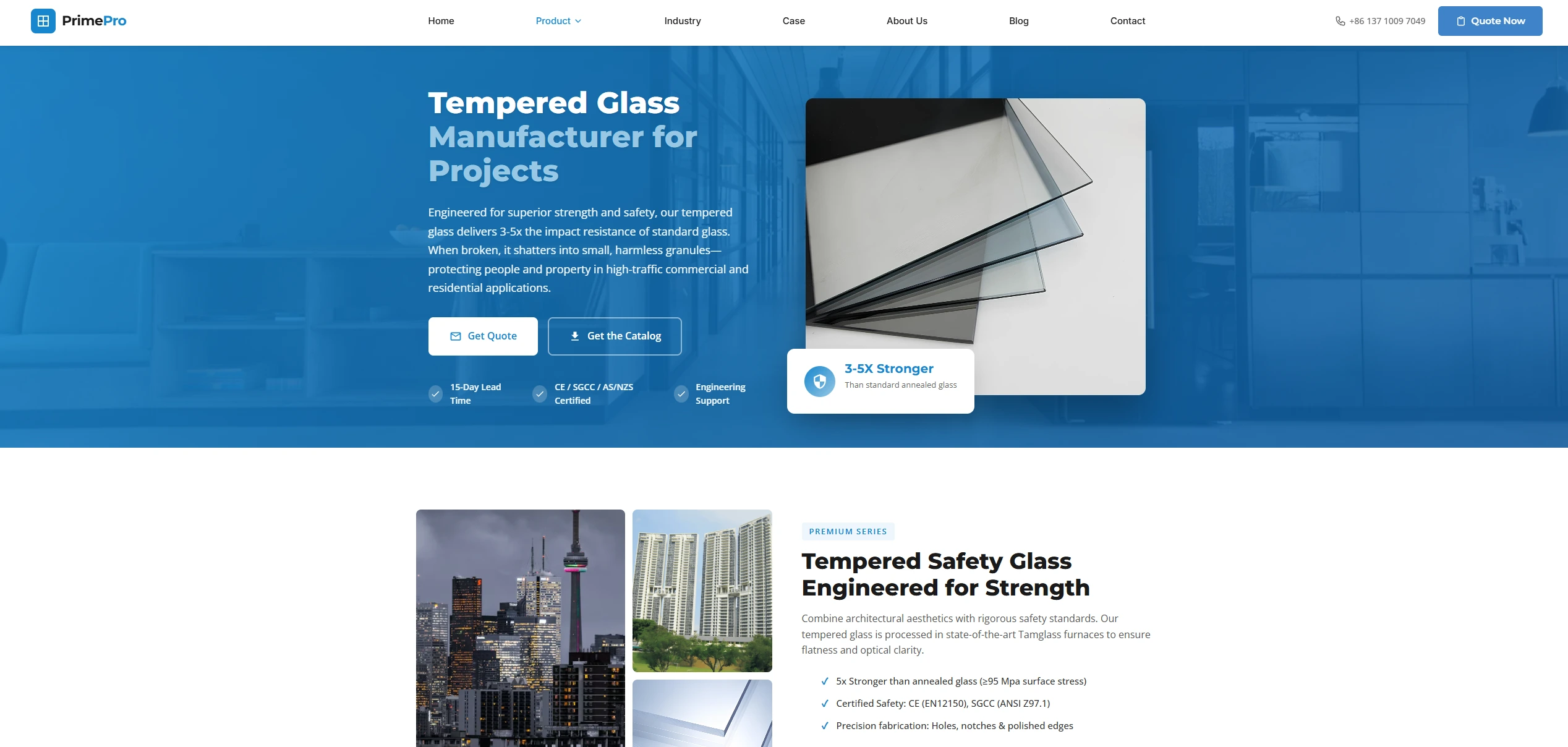
1. Prime Pro
- Headquarters: China
- Core Certifications: SGCC, IGCC, AS/NZS 2208:1996, ISO9001:2008
Brand History & Scale: Founded in the early 1990s, my team currently operates a 40,000-square-meter modernized manufacturing facility supported by 500 skilled technical personnel. Consequently, we maintain a robust annual processing capacity exceeding 4,000,000 square meters.
Core Technical Advantage: We utilize an automated processing line featuring a Tamglass dual-chamber convection furnace capable of producing 3300x6000mm oversize glass. Furthermore, we strictly execute the BS EN14179-1:2005 Heat Soak standard. This thermal process forces a 24% volume expansion in Nickel Sulfide (NiS) impurities, safely detonating defective glass in the oven. Therefore, we heavily mitigate post-installation spontaneous breakage. Our tempered glass delivers 3 to 5 times stronger impact resistance compared to standard annealed glass.
Donnie’s Expert Perspective: As a direct factory operator, I ensure our production line prioritizes architectural-grade customization. We offer extreme flexibility for mid-sized project managers who require strict dimensional tolerance for complex drill holes and obtuse angles. Consequently, we provide rapid technical communication and field-tested structural integrity, securing a highly optimized ROI without multi-layered distributor markups.
| Dimension | Details |
|---|---|
| Core Strength | Oversize custom processing & strict NiS control |
| Certifications | SGCC, AS/NZS 2208:1996, 3C |
| Target Market | Mid-to-large Facade/Window Contractors |
| Delivery Speed | Highly Agile / Direct Factory Response |
| Pricing Tier | Highly Competitive ROI |
4. Guardian Glass
- Headquarters: USA
- Core Certifications: SGCC, CE, ISO
Brand History & Scale: This American manufacturer is globally recognized for its extensive network of float lines and deep-processing fabrication centers, supporting massive commercial glazing contracts across multiple continents.
Core Technical Advantage: Their primary strength lies in tempering synergy. They engineer their low-emissivity coatings specifically to withstand the intense thermal stress of the tempering furnace. Thus, the resulting architectural glass achieves excellent energy efficiency while maintaining necessary safety ratings.
Donnie’s Expert Perspective: Their coating technology is exceptional for large-scale energy-efficient building envelopes. However, their strategic focus firmly targets massive, high-profile commercial developments. Consequently, mid-tier procurement managers seeking aggressive cost-efficiency and hands-on factory-level CAD troubleshooting may find their premium markups and tiered service structure less suited for their specific operational needs.
| Dimension | Details |
|---|---|
| Core Strength | Advanced coating thermal compatibility |
| Certifications | SGCC, IGCC, CE |
| Target Market | Premium Commercial Developments |
| Delivery Speed | Distributor Dependent |
| Pricing Tier | Premium |
5. NSG Pilkington
- Headquarters: UK / Japan
- Core Certifications: CE, SGCC, EN
Brand History & Scale: As the historic inventors of the modern float glass process, they operate a vast global manufacturing footprint. They provide highly trusted base materials and safety glass products to countless architectural markets.
Core Technical Advantage: Their deep understanding of raw glass chemistry allows them to execute highly stable tempering processes. Furthermore, they maintain precise thermal gradients during processing, which effectively minimizes edge-stress weaknesses in the finished panels.
Donnie’s Expert Perspective: Their historical pedigree and baseline quality are absolute benchmarks in our industry. Yet, because they frequently rely on third-party authorized processors for regional custom fabrication, the ultimate dimensional precision can vary. Therefore, this delegated processing model might be unfit for contractors who demand centralized, single-source factory accountability for rigorous project QA.
| Dimension | Details |
|---|---|
| Core Strength | Material chemistry & consistency |
| Certifications | CE, ISO, EN |
| Target Market | Global Commercial Architecture |
| Delivery Speed | Varies by Regional Processor |
| Pricing Tier | High |
6. Sisecam
- Headquarters: Turkey
- Core Certifications: CE, EN, ISO
Brand History & Scale: Operating as a dominant force across Europe and the Middle East, they manage massive continuous float lines and extensive downstream tempering capacities to feed high-volume construction demands.
Core Technical Advantage: They leverage economies of scale effectively. They utilize high-throughput continuous tempering furnaces that deliver consistent, standardized safety glass at an incredibly rapid industrial pace.
Donnie’s Expert Perspective: They offer an outstanding solution for securing standard-sized toughened glass in massive bulk. However, when an architectural project dictates complex, non-standard processing—such as intricate CNC routing, rigorous hole-placement tolerances, or bespoke oversize panels—their high-speed bulk model often proves less suited compared to a factory dedicated to specialized architectural customization.
| Dimension | Details |
|---|---|
| Core Strength | Massive bulk tempering capacity |
| Certifications | CE, ISO, EN |
| Target Market | High-Volume European/MENA Projects |
| Delivery Speed | Fast for Standard Bulk |
| Pricing Tier | Moderate to High |
7. Vitro Architectural Glass
- Headquarters: USA
- Core Certifications: SGCC, IGCC
Brand History & Scale: Following their acquisition of PPG’s flat glass business, they stand as the dominant supplier in the North American market, commanding massive domestic processing volume and strong architectural specifications.
Core Technical Advantage: They excel at tempering ultra-clear and high-performance low-E glass substrates without compromising light transmittance. Consequently, their products deliver outstanding visual neutrality and safety for expansive curtain wall designs.
Donnie’s Expert Perspective: For contractors operating exclusively within standard domestic US supply chains, their quality is superb. However, their pricing structure is inherently tied to high domestic manufacturing costs. Thus, international buyers or US procurement managers actively sourcing overseas to maximize project margins will find their domestic premium unfit for aggressive budget optimization.
| Dimension | Details |
|---|---|
| Core Strength | High-performance low-E tempering |
| Certifications | SGCC, IGCC |
| Target Market | North American Premium Commercial |
| Delivery Speed | Fast (Domestic US) |
| Pricing Tier | Very High (Domestic Premium) |
8. Taiwan Glass
- Headquarters: Taiwan / China
- Core Certifications: 3C, SGCC, CE
Brand History & Scale: As one of the largest integrated glass groups in Asia, they operate numerous sprawling industrial bases. They consistently supply immense volumes of processed glass to the regional B2B construction sector.
Core Technical Advantage: Their extensive infrastructure allows them to maintain strict baseline quality control across massive production batches. Therefore, their tempered panels demonstrate reliable structural safety ratings and uniform surface compression.
Donnie’s Expert Perspective: Their sheer output capacity provides excellent supply stability for standard regional developments. Nevertheless, their primary business model heavily prioritizes massive domestic B2B distribution. Consequently, overseas procurement managers requiring white-glove project management, rapid English technical support, and strict export-grade packaging might find their localized volume focus unfit for precise cross-border engineering workflows.
| Dimension | Details |
|---|---|
| Core Strength | Massive Asian distribution capacity |
| Certifications | 3C, SGCC |
| Target Market | Large-scale Domestic/Regional B2B |
| Delivery Speed | Steady |
| Pricing Tier | Moderate |
9. CSG Holding
- Headquarters: China
- Core Certifications: 3C, SGCC, AS/NZS 2208
Brand History & Scale: They are a formidable pioneer in the domestic architectural glazing market, particularly renowned for supplying advanced safety glass to high-profile commercial skyscrapers across major metropolitan centers.
Core Technical Advantage: They possess elite engineering capabilities for processing sophisticated commercial facades. Furthermore, they successfully integrate high-grade tempering with advanced energy-saving coatings to meet strict municipal building codes.
Donnie’s Expert Perspective: Their technical execution on tier-1 domestic structures is highly impressive. Yet, because their production queues are frequently saturated with massive, state-level building contracts, their lead times can fluctuate. Consequently, mid-sized overseas contractors requiring priority scheduling and dedicated factory-direct attention may find their resources unfit when project deadlines are extremely tight.
| Dimension | Details |
|---|---|
| Core Strength | Commercial skyscraper glazing |
| Certifications | 3C, SGCC, ISO |
| Target Market | Tier-1 Domestic Mega-Projects |
| Delivery Speed | Queue Dependent |
| Pricing Tier | Moderate to High |
10. Xinyi Glass
- Headquarters: China
- Core Certifications: 3C, SGCC, ISO
Brand History & Scale: They rank among the top global manufacturers of raw float glass and automotive glass, maintaining massive industrial parks and driving significant segments of the global supply chain.
Core Technical Advantage: Their absolute control over upstream raw materials guarantees exceptional baseline float quality. Thus, any glass entering their architectural tempering division inherently features fewer raw defects and superior thickness consistency.
Donnie’s Expert Perspective: Their raw material dominance is an undeniable industrial advantage. However, because their corporate revenue relies heavily on raw float sales and standardized automotive contracts, their architectural deep-processing division tends to prioritize volume. Therefore, contractors seeking an agile partner for small-batch, highly complex facade modifications often find this massive structure less suited for their dynamic needs.
| Dimension | Details |
|---|---|
| Core Strength | Upstream raw float quality |
| Certifications | 3C, CE, SGCC |
| Target Market | Large-scale wholesale & Automotive |
| Delivery Speed | Standard Corporate |
| Pricing Tier | Moderate |
Conclusion
Navigating B2B architectural glass procurement requires balancing absolute structural safety with strict project budgets. My team ensures your custom facade requirements meet rigorous tolerances without excessive distributor markups. For direct factory consultation and certified processing, contact me at info@primeproglass.com.
How to Choose the Right Tempered Glass Manufacturers
Selecting a reliable factory for your facade project requires careful risk management. You need a partner that protects both your project timeline and your budget. Therefore, I always advise B2B buyers to focus on three critical factors.
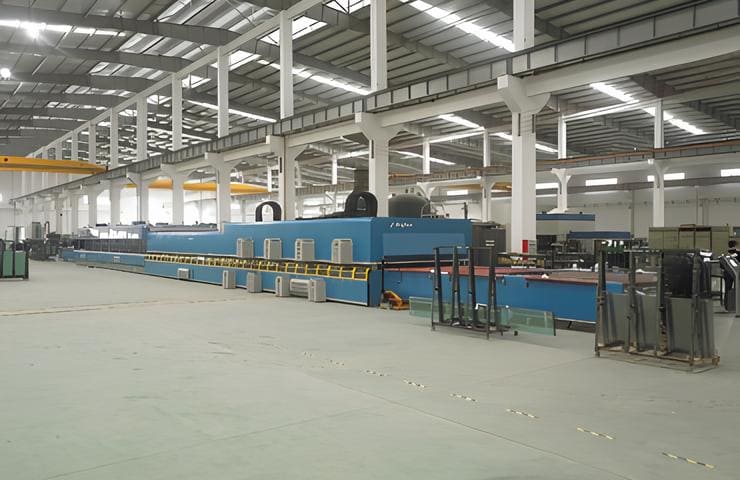
Core Processing Equipment: High-performance glass requires advanced machinery. For instance, you should look for factories utilizing automated cutting lines and Tamglass convection furnaces. This equipment ensures excellent optical clarity. Furthermore, it strictly minimizes roller wave distortion, which is essential when processing oversize panels up to 3300x6000mm.
Strict Safety Certifications: Never compromise on building safety. You must ensure the manufacturer strictly executes the Heat Soak Test under the BS EN14179-1:2005 standard. This thermal process forces a 24% volume expansion in Nickel Sulfide (NiS) impurities. Thus, it safely detonates defective glass inside the oven, preventing catastrophic spontaneous breakage on-site. Additionally, always verify their physical SGCC, IGCC, and AS/NZS 2208:1996 certifications.
Custom Dimensional Precision: Architectural blueprints require exact tolerances. While massive float glass conglomerates prioritize bulk volume, custom facade projects demand precise drilling, edge grinding, and obtuse angle cuts. Therefore, choose a direct factory that strictly controls CAD tolerances before the tempering process. This focus ensures your architectural glass aligns perfectly with the metal frames during field assembly, avoiding costly installation delays.
B2B Purchasing Comparison Dimensions
| Dimension | What to Check | Why it Matters |
|---|---|---|
| Capacity & Equipment | Factory size, automated cutting lines, Tamglass furnace capabilities. | Ensures the supplier can handle large volume peaks and oversize panel processing without outsourcing. |
| Spontaneous Breakage Control | Implementation of Heat Soak Test (BS EN14179-1:2005). | Forces NiS expansion in the oven, preventing catastrophic glass shattering after building installation. |
| Dimensional Tolerance | CNC routing accuracy and pre-tempering edge grinding protocols. | Guarantees the glass aligns perfectly with metal facade frames, avoiding severe on-site assembly delays. |
| Safety Certifications | Readily available SGCC, IGCC, and AS/NZS 2208:1996 test reports. | Provides strict compliance documentation necessary to pass rigorous international building safety inspections. |
| Export Packaging | Use of fumigation-free plywood crates, steel banding, and cork pads. | Neutralizes transit vibration and prevents edge chipping during extended cross-border sea freight logistics. |
Frequently Asked Questions (B2B Focus)
How do you guarantee the dimensional, drilling, and edging tolerances for custom tempered glass orders before the tempering process?
We deploy computer-controlled automated cutting and four-edge grinding machines directly linked to your project CAD files. Therefore, we lock down strict dimensional tolerances before the glass enters the tempering furnace. This ensures seamless on-site installation without structural misalignments.
What specific document support and certifications (e.g., SGCC, AS/NZS 2208) can your factory provide for building safety inspections?
My team provides fully traceable compliance documentation. Specifically, we supply the US SGCC certification, US IGCC, and Australian AS/NZS 2208:1996 test reports. Furthermore, every batch includes our ISO9001:2008 quality control logs to guarantee swift field approvals.
How does your Heat Soak Test (BS EN14179-1:2005) process effectively minimize the risk of spontaneous breakage caused by Nickel Sulfide (NiS) inclusions?
We hold the tempered glass at extreme temperatures inside a calibrated oven. Consequently, this thermal cycle triggers a 24% volume expansion in any hidden NiS impurities. The defective glass shatters safely in our factory, heavily mitigating post-installation spontaneous breakage risks.
How do you control the roller wave distortion and overall flatness of oversized tempered glass to ensure high optical quality?
We utilize advanced Tamglass dual-chamber convection tempering furnaces equipped with synchronous roll table technology. Thus, we maintain precise, even heating and rapid cooling cycles. This strictly minimizes roller wave distortion, ensuring outstanding optical clarity and structural integrity across oversized panels.
For B2B cross-border sea freight, how do you pack the tempered glass to prevent edge damage and breakage during transit?
We utilize heavy-duty, fumigation-free plywood crates reinforced with steel banding. Additionally, we place cork pads or protective paper layers between each glass sheet to prevent surface friction. Therefore, this rigorous packaging strategy neutralizes vibration, preventing edge chipping and transit breakage.