Tempered glass breaks into small, relatively harmless granules because it is a pre-stressed safety material designed to release high internal energy upon failure. For stakeholders in the commercial sector, sudden structural failure is not just a maintenance headache; it is a significant liability risk. You might face the unexpected “explosion” of a large partition in a high-traffic lobby, leading to immediate panic and costly operational downtime. Fortunately, identifying the specific triggers of a tempered glass break allows you to implement rigorous inspection protocols and select superior fabrication partners.
1. Can a deep scratch cause a tempered glass break?
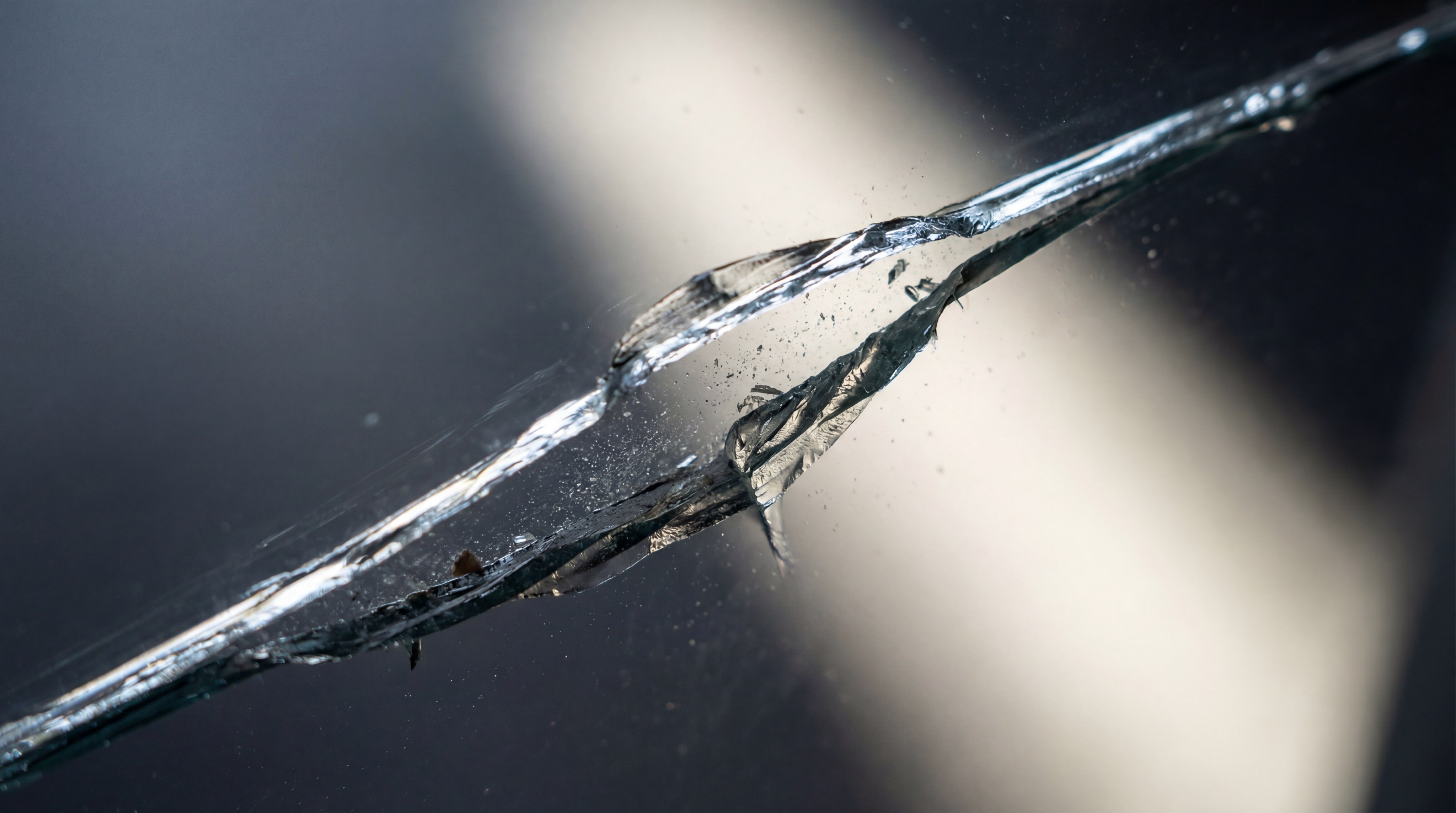
Yes, a deep scratch that penetrates the outer compressive layer to reach the inner tension zone will trigger an immediate total failure. A tempered glass break often starts at the microscopic level where surface integrity is compromised. You must realize that even a minor-looking groove from construction debris can act as a fuse for the entire pane.
Why surface depth matters?
The outer surface of your glass is under intense compression, which provides its strength. But that’s not all. Once a scratch pierces the compressed “envelope” and reaches the center, the stored energy is released.
- Carbide scrapers used during improper cleaning.
- Gritty sand or construction dust trapped in gaskets.
- Intentional vandalism or accidental tool strikes.
Identifying critical scratches
You should regularly inspect your glass for any defects that feel deep to the touch. Here is why: a scratch that you can catch with a fingernail often exceeds the safety threshold of the compression layer.
The following table summarizes the relationship between surface damage and failure risk:
| Damage Type | Layer Impacted | Risk Level |
|---|---|---|
| Surface Scuff | Outer 5% | Low |
| Visible Scratch | Outer 15% | Moderate |
| Deep Gouge | 20%+ Depth | Critical |
Evaluating these defects early is the only way to prevent a catastrophic collapse of your structural glass elements. Key Takeaway: Any scratch deep enough to reach the inner tension zone transforms the glass into a ticking clock for failure.
2. Why does a tempered glass break into small granules?
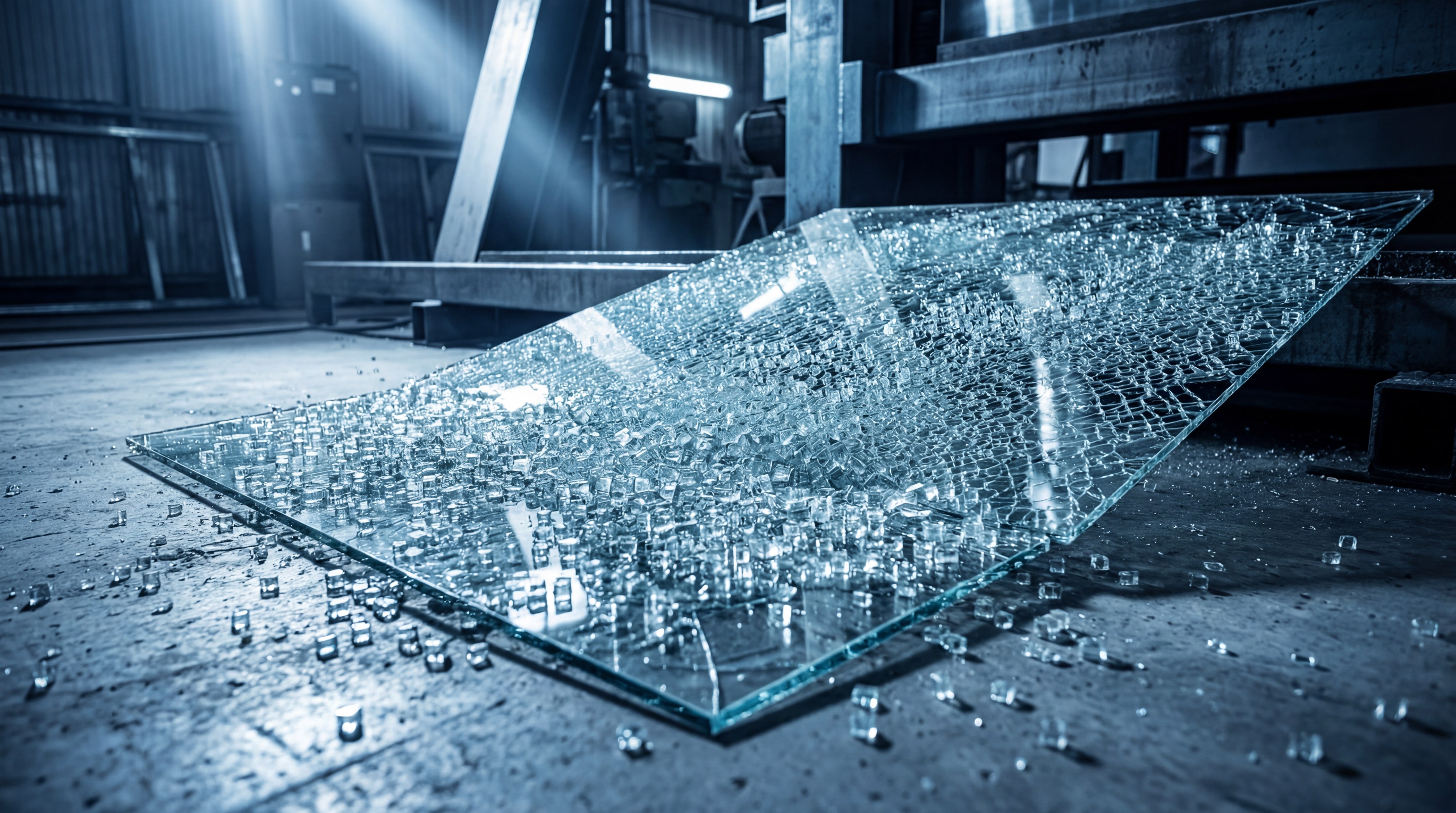
Tempered glass crumbles into small pieces because the high internal tension forces the material to disintegrate simultaneously once the surface compression is lost. This characteristic tempered glass break pattern is specifically engineered to prevent the formation of large, lethal shards. You will find that these “dice-like” fragments are far safer for occupants in the event of an accident.
The science of dicing
The fragmentation process is governed by the balanced stresses within the glass. Look at the facts: the energy stored during the cooling phase dictates how small the pieces will become.
- Uniform stress creates smaller, blunter granules.
- Uneven tempering leads to larger, sharper fragments.
- High-pressure quenching increases the fragmentation count.
Safety benefits of granulation
You gain a significant reduction in liability when using glass that breaks this way. But wait, there’s more. The blunt edges of these granules are much less likely to cause deep lacerations compared to annealed glass.
The table below outlines how fragmentation standards define safety in commercial applications:
| Standard | Fragment Count (5x5cm) | Safety Rating |
|---|---|---|
| ASTM C1048 | 40+ Pieces | High |
| EN 12150 | 40+ Pieces | High |
| Non-Tempered | 0-5 Pieces | Dangerous |
Understanding these patterns helps you verify if your supplier is meeting the necessary safety codes. Key Takeaway: The “dice” pattern is a deliberate engineering success that prioritizes human safety by minimizing sharp edges during failure.
3. What role does NiS play in a tempered glass break?
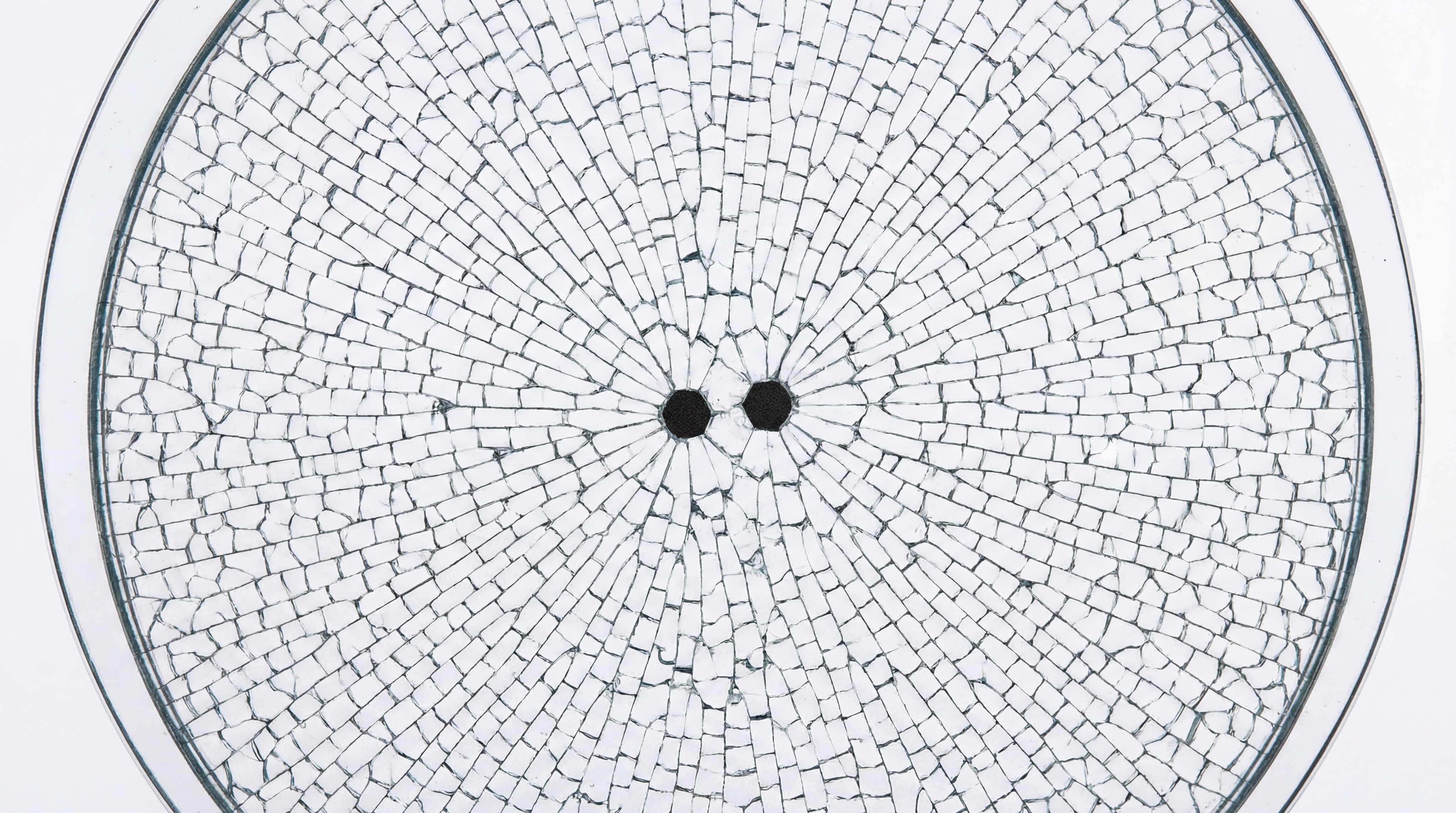
Nickel Sulfide (NiS) inclusions cause spontaneous failure because these microscopic impurities expand over time, creating localized stress that exceeds the glass’s strength. A tempered glass break caused by NiS often occurs without any external impact or obvious trigger. You might discover a shattered pane months or even years after the initial installation.
The butterfly break pattern
If you see two central fragments that look like wings, you are likely looking at a NiS failure. Here is the thing: the inclusion acts as a point of origin that radiates cracks outward in a very specific geometry.
- Centered origin point between two “wings.”
- No evidence of mechanical impact at the center.
- Typical of spontaneous breakage in high-heat zones.
Preventing NiS failure with heat soaking
You can significantly reduce the risk of on-site failure by requesting Heat Soak Testing (HST). It gets better: this process forces defective panes to break in the controlled environment of the factory instead of your building.
This comparison shows how testing protocols impact the longevity of your glass project:
| Factor | Standard Tempered | Heat Soaked Tempered |
|---|---|---|
| NiS Failure Risk | ~1% | <0.01% |
| Production Cost | Baseline | +15-20% |
| Reliability | Standard | Maximum |
Using advanced testing ensures your architectural installations remain intact for decades. Key Takeaway: While NiS is an inherent raw material impurity, professional heat soaking is your best defense against spontaneous breakage.
4. Does thermal stress lead to a tempered glass break?

Thermal stress leads to failure when a significant temperature difference between the center and the edge of a pane causes uneven expansion. Your project might experience a tempered glass break if dark-tinted glass absorbs excessive solar radiation while the edges remain cool in the frame. You must account for these temperature gradients during the design and material selection phase.
Solar heat gain risks
The center of the glass heats up in direct sunlight and tries to expand. Think about it: the edges are often shaded by the framing system and remain relatively cold and rigid.
- Darker tints absorb more thermal energy.
- Partial shading on the pane creates high gradients.
- High-altitude locations increase UV and heat exposure.
Thermal shock resistance limits
You should know that while tempered glass is tough, it still has thermal limits. But that’s not all. A temperature difference of over 150°C can be enough to overcome the structural integrity of the pane.
The following data highlights the thermal thresholds for various glass types:
| Glass Type | Thermal Delta Limit | Resistance |
|---|---|---|
| Annealed | ~40°C | Low |
| Heat-Strengthened | ~100°C | Moderate |
| Fully Tempered | ~250°C | High |
Selecting the right glass type based on your building’s orientation and local climate is crucial. Key Takeaway: Managing thermal gradients through proper framing and glass selection prevents stress-induced shattering.
5. Can bowing indicate a future tempered glass break?
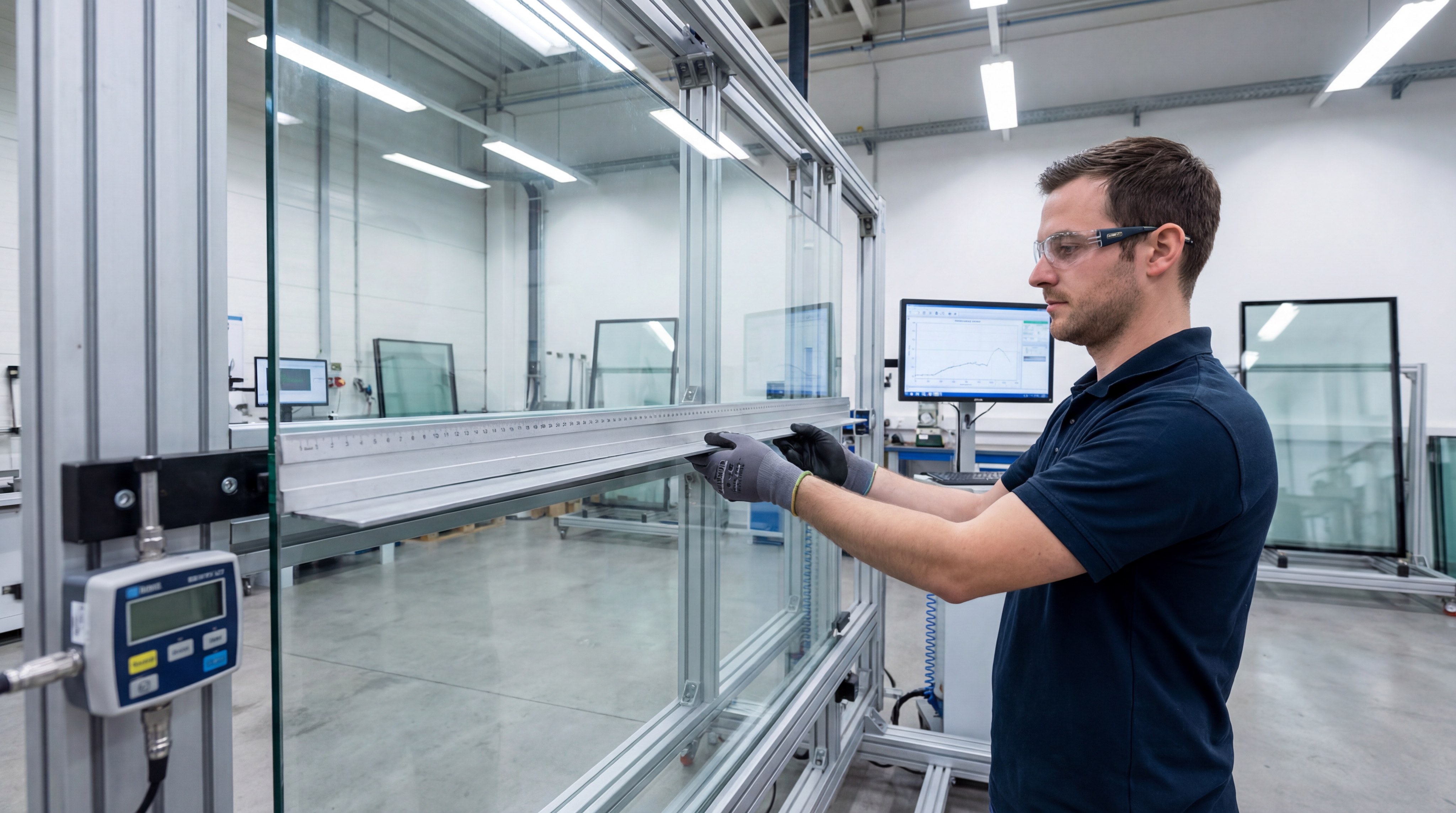
Yes, excessive bowing or warping suggests that the glass is under constant mechanical strain, which can eventually lead to fatigue and failure. In a tempered glass break scenario involving bowing, the glass often fails because it was improperly sized for the wind load. You can often see these distortions as “oil canning” or wavy reflections on the building’s facade.
Identifying manufacturing warpage
During the tempering process, the glass can slightly deform if it is not supported correctly in the furnace. You might notice these waves when looking at the glass from a sharp angle.
- Roller waves from the furnace bed.
- Overall bow or “dish” across the entire pane.
- Edge kink near the perimeter of the unit.
Wind load and deflection
You must ensure that your glass thickness matches the expected environmental pressure. But wait, there’s more. Repeated flexing from high winds can cause micro-fractures to grow until the glass gives way.
This table details the acceptable limits for architectural glass deformation:
| Parameter | ASTM C1048 Limit | Significance |
|---|---|---|
| Roller Wave | 0.08mm per 300mm | Visual Clarity |
| Overall Bow | 1/200 of span | Structural Fit |
| Edge Lift | 0.5mm | Gasket Seal |
Monitoring these metrics during procurement ensures you receive flat, stable panes. Key Takeaway: Visible warpage is a red flag that indicates either manufacturing defects or improper structural load handling.
6. Why do edge hits cause a tempered glass break?
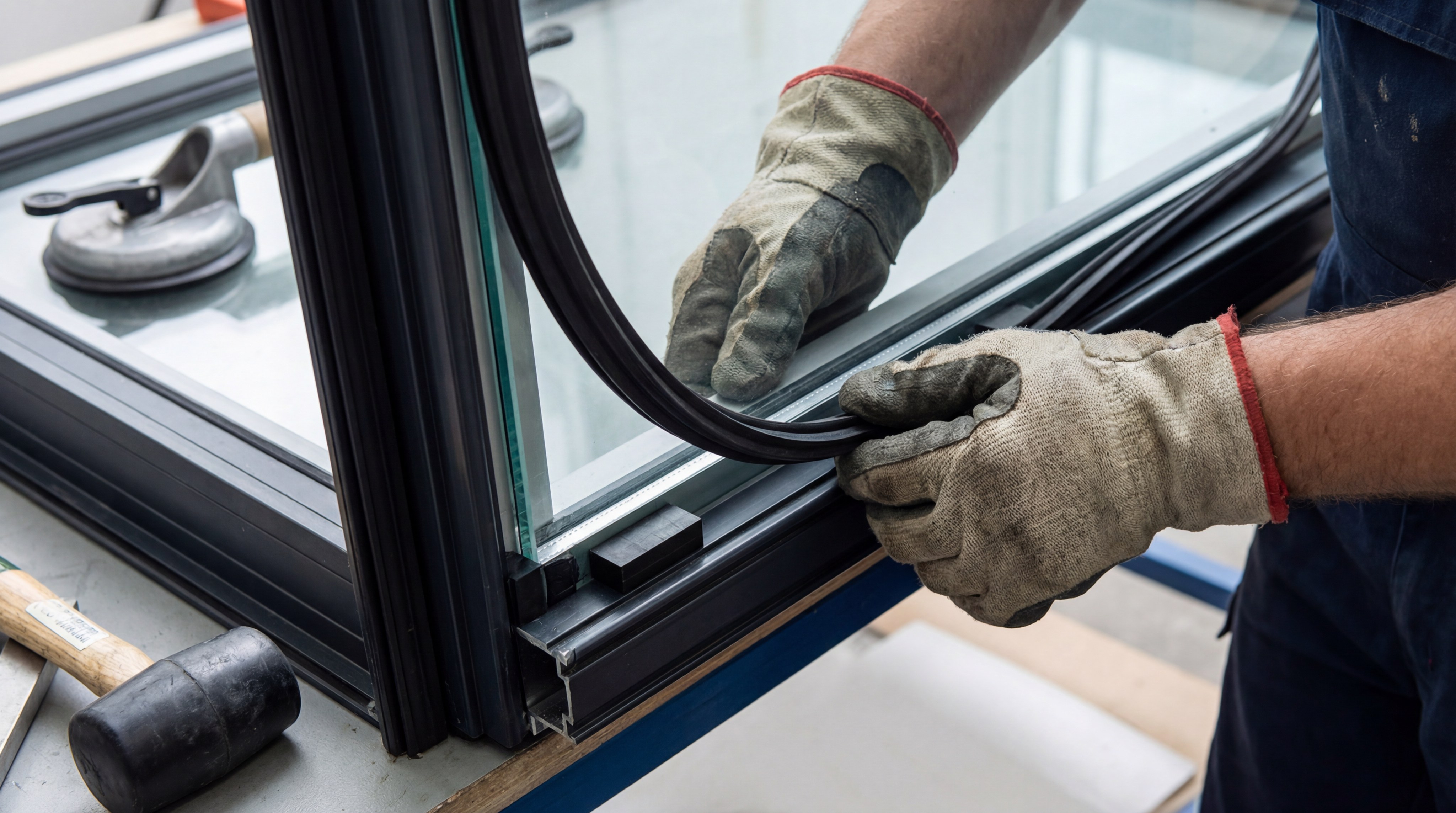
The edges are the weakest part of the pane because the compressive layer is thinnest there, making any direct impact highly dangerous. A sudden tempered glass break often occurs because the glass makes direct contact with a metal frame or a hard screw head. You must ensure that your installers use high-quality EPDM gaskets to cushion these vulnerable perimeters.
The vulnerability of the corners
Corners represent a convergence of stresses where the glass is most susceptible to chipping. Here is the thing: a minor chip on the edge can propagate instantly into a full-pane failure.
- Metal-to-glass contact during installation.
- Over-tightened structural glazing clips.
- Settling of the building foundation over time.
Using setting blocks correctly
You should always verify that setting blocks are placed according to the manufacturer’s specifications. It gets better: these small pieces of rubber prevent the glass from resting on hard, uneven surfaces.
The table below summarizes best practices for edge protection:
| Component | Recommended Material | Function |
|---|---|---|
| Setting Blocks | Neoprene / EPDM | Weight distribution |
| Perimeter Seals | Silicone / Gaskets | Vibration damping |
| Shims | Non-metallic | Leveling protection |
Proper cushioning is the most effective way to prevent accidental edge-induced shattering. Key Takeaway: Protecting the edges with resilient materials is non-negotiable for long-term glass stability.
7. Is a hammer strike the only way to trigger a break?
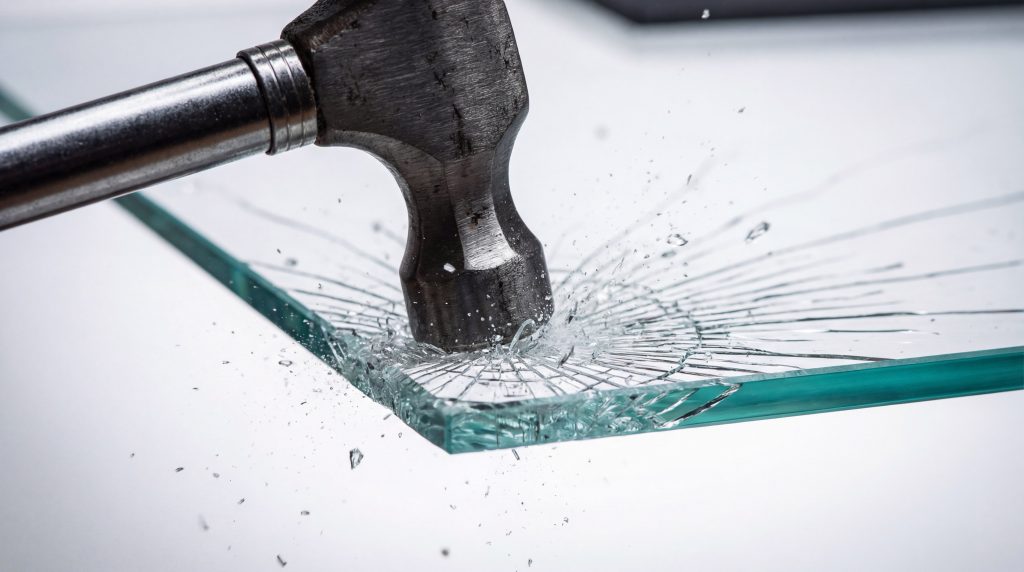
No, while high-velocity impacts certainly cause failure, even a low-energy tap on a vulnerable edge can trigger a total tempered glass break. You might be surprised to learn that a blunt blow to the face of the pane is often resisted, while a sharp point strike is fatal. You must handle every unit with extreme caution, especially during transportation and unboxing.
Point load vs. distributed load
Tempered glass is designed to withstand high distributed loads, like wind or people leaning on it. But that’s not all. If all that force is concentrated on a single sharp point, the surface tension is easily breached.
- Hardened steel tools hitting the surface.
- High-heel shoes on a glass floor.
- Flying pebbles or hail during storms.
Impact resistance in testing
You can rely on safety certifications to know what your glass can truly handle. Here is why: standardized tests involve dropping heavy weights to simulate real-world accidents.
This table compares how different impactors affect tempered glass integrity:
| Impactor | Surface Effect | Edge Effect |
|---|---|---|
| Soft Body (Ball) | Deflection (Safe) | Vibration Risk |
| Hard Body (Steel) | Scuffing / Failure | Immediate Break |
| Pointed Tool | High Failure Risk | Instant Shatter |
Designing for impact resistance involves choosing the correct glass thickness for your specific application. Key Takeaway: Energy concentration is the primary enemy of tempered glass; avoid sharp point contact at all costs.
8. What happens in a lobby tempered glass break?

In a commercial lobby, a failure results in a loud “bang” followed by a cascade of granules that spread quickly across the floor. This type of tempered glass break is highly disruptive and requires an immediate professional response to ensure safety. You must have a clear cleanup protocol in place to prevent secondary injuries from the remaining debris.
Immediate safety responses
Your first priority should be to clear the area and prevent anyone from walking through the glass. But wait, there’s more. Even small granules can be sharp enough to cause surface cuts or get caught in clothing.
- Use caution tape to cordon off the zone.
- Instruct staff to wear heavy-duty gloves.
- Utilize industrial vacuums for complete removal.
Cleanup and forensics
You should keep a few samples of the broken glass if you suspect a manufacturing defect. Here is the thing: analyzing the fracture origin can help you determine if NiS or an impact was the cause.
The following table outlines the steps for a professional glass failure response:
| Phase | Action | Priority |
|---|---|---|
| Safety | Evacuate / Cordon | Immediate |
| Forensics | Photo-document origin | High |
| Remediation | Industrial vacuum / Replacement | Normal |
A fast response minimizes business downtime and protects your customers from harm. Key Takeaway: Rapid cleanup and forensic analysis are essential for maintaining safety and investigating liability after a failure.
9. How does polarization reveal a tempered glass break?

Polarized lenses reveal the internal stress patterns, which can highlight areas of uneven tension that might lead to a tempered glass break. When you look through a polarizer, you will see a “rainbow” or “leopard spot” effect. You can use this simple tool to verify if a pane has been properly tempered or if it contains dangerous stress concentrations.
Visualizing internal tension
The rainbow pattern is a direct visual representation of the energy stored within the material. Think about it: a lack of pattern might indicate that the glass was never tempered at all.
- Dark spots indicate high compression.
- Uniform rainbows suggest consistent heat treatment.
- Irregular clusters signal potential failure points.
Professional inspection tools
You can invest in specialized scanners if your project involves thousands of panes. But that’s not all. These digital tools provide a quantifiable map of the stress distribution across the surface.
This comparison shows what to look for during a polarized inspection:
| Pattern | Meaning | Action |
|---|---|---|
| Uniform Spots | Quality Tempering | Proceed |
| Faint / No Pattern | Annealed Glass | Reject (If safety req.) |
| Intense Asymmetry | High Internal Stress | Monitor / Replace |
Using polarization is a cost-effective way to conduct non-destructive testing on-site. Key Takeaway: Visualizing stress allows you to identify manufacturing flaws before they manifest as a structural failure.
10. Does the stress balance prevent a tempered glass break?
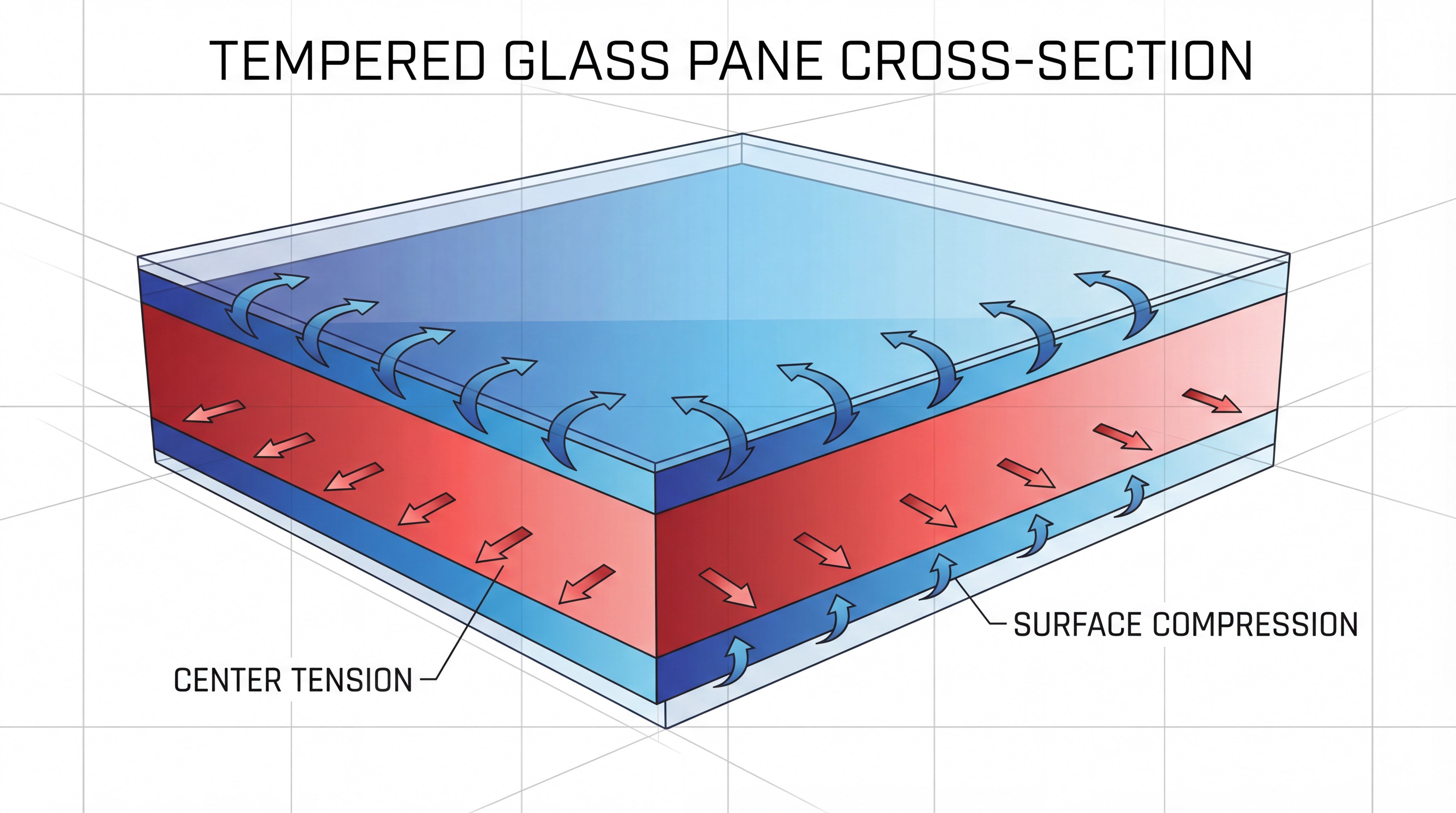
Yes, the delicate balance between surface compression and center tension is what gives the glass its strength, but any disruption to this equilibrium causes failure. In every tempered glass break, the core’s expansion force overcomes the surface’s contraction force. You must respect this physical limit by avoiding any drilling or cutting after the glass has been tempered.
The permanent tension core
The core of your glass pane is constantly trying to pull itself apart. Here is the thing: the only thing stopping it is the incredibly dense surface layer that was “frozen” during quenching.
- Surface compression: >69 MPa (10,000 psi).
- Center tension: Equal and opposite pull.
- Equilibrium: The state of structural stability.
Post-tempering modification risks
You should never attempt to modify a tempered pane after it leaves the furnace. But wait, there’s more. Any attempt to drill a hole or grind an edge will release the internal tension instantly.
The following table explains the mechanical properties of the stress-balanced state:
| Property | Value (Typical) | Benefit |
|---|---|---|
| Tensile Strength | 120-200 MPa | Impact resistance |
| Compressive Stress | 69-170 MPa | Surface durability |
| Fragmentation | 40+ granules | Safety failure |
Maintaining the integrity of the stress layers is the key to architectural glass performance. Key Takeaway: The strength of tempered glass is a result of locked-in energy; any breach of the surface “skin” releases this energy violently.
FAQ: Professional Inquiries on Glass Failure
Can I stop a crack from spreading in tempered glass?
No, you cannot. Once a crack begins in tempered glass, the internal tension causes the entire pane to disintegrate instantly into granules.
What’s the best way to handle glass during installation?
Always protect the edges and corners with non-metallic spacers. Professional glazing requires that the glass never makes direct contact with hard framing materials or fasteners.
Can I tell if the break was spontaneous or caused by impact?
Yes, by looking for the “butterfly” pattern. If the break radiates from two central wing-like fragments without a clear impact point, it is likely a NiS inclusion.
What’s the best way to clean commercial tempered glass?
Use only soft cloths and non-abrasive detergents. You must avoid carbide scrapers or metal tools that could create the microscopic scratches that lead to failure.
Can I drill a hole in tempered glass?
No, absolutely not. All fabrication, including cutting and drilling, must be completed before the tempering process begins; otherwise, the glass will shatter.
Conclusion
Understanding the mechanics of a tempered glass break is essential for maintaining safe and high-performing commercial environments. While the granular failure mode is a safety triumph, the potential for spontaneous failure due to NiS or thermal stress demands professional vigilance. By prioritizing precision fabrication, heat soak testing, and expert installation protocols, you can significantly mitigate the risks of structural glass failure.
For architectural projects that demand the highest safety ratings and structural longevity, you need a manufacturing partner with decades of technical expertise. Contact us today to discuss your custom fabrication requirements and ensure your next project is built with the highest industry standards. Our vision is to lead the glass industry through innovation and uncompromising quality control, keeping your spaces safe and beautiful.